Sunday, September 21, 2025

Making Korean Verbs Negative Part 2

Hello My fellow students this is Making Korean Verbs Negative Part 2. In part one we learned two important words 안“an” which means “not” and 못 “mot” which means “can’t” and we learned how to add them to verbs to make them negative. In this lesson we will learn another way to make verbs negative and it will look kinda similar to ‘an’ and ‘mot’ but different You’ll see. I’ll show you.


Let’s start with “not”. 

If you’ve got a verb like 자다 (ja-da) to sleep you can turn it into to not sleep like this:

First cut off the -da and then add + 않다 (ji an-da) to the end

Now we have to not sleep 자지 않다 ja-ji an-da.

Now we have a negative verb in the infinitive form. And from here we can conjugate it into any tense we like. For example the simple present

“Don’t sleep”

Ja-ji an-a 자지 않아

Ja-ji an-a-yo 자지 않아요

Jaji an-seum-ni-da


You can do this with any verb and any adjective because in Korean adjectives are verbs.


Now let’s do “can’t”

We’ll use ja-da again as an example “to sleep” let’s turn it into “to can’t sleep”

First we cut off the -da and then add + 못하다 (ji mot-ha-da) to the end

Now we have to cant sleep ja-ji mot-ha-da. 

It’s a negative verb! And it can be conjugated into any tense you like. Here’s my preferred Example the simple present ‘I can’t sleep’ in the casual, polite and formal forms respectfully

나는 자지 못해 Na-neun ja-ji mot-hae

저는 자지 못해요 Jeo-neun ja-ji mot-hae-yo

저는 자지 못합니다 Jeo-neun ja-ji mot-ham-ni-da


This method can be used with ANY verb or ANY adjective.


And it’s just that simple. We now know how to turn “to verb” into “ to not verb” and “ to can’t verb”. Simple remove the -da and add “ji an-da” or “ji mot-ha-da”. I works universally for any verb or adjective. Now go forth and negate the practice words! Thanks for studying with me. 

WATCH THE LESSON: https://www.youtube.com/watch?v=5CtekiyQT70

Tuesday, December 31, 2024

Making Korean Verbs Negative - Part 1 Summary


WATCH THE LESSON!
https://youtu.be/P3w0DMiOqhU?si=IqvcdYfafpXE9SqL


Making Negative Korean Verbs - Part1

This lesson is our first lesson on making verbs negative in Korean.

There are a couple ways to do it.

The first way is by adding “an” to the beginning of the verb. “an” is like the start of the word for “no” in Korean 아니요 (a-ni-yo).

So you take a verb like “to sleep” 자다 (ja-da). add (an) to make it “to not sleep” 안자다 (an-ja-da)

How can you say “I do not sleep”

Remember how to conjugate? 

나는 안자 na-neun an-ja

저는 안자요 jeo-neun an-ja-yo

저는 안잡니다 Jeo-neun an-jam-ni-da

You can conjugate these negative verbs into any tense you want.

You can do the same with adjectives, because in Korean adjectives are verbs For example “to be big” is 크다 (keu-da) We can add (an) to make it 안크다 (an-keu-da) “to be not big”.

It’s not big is

안커 (an-keo)

안커요 (an-keo-yo)

안큽니다 (an-keum-ni-da)

Another way to make verbs negative is to add (mot) in front of the verb. (mot) means “cannot”. For example we can add 못 (mot) in front of 자다 (ja-da) to make it into can’t sleep (mot ja-da). I can’t sleep:

나는 못 자 (na-neun mot ja)

저는 못 자요 (jeo-neun mot ja-yo)

저는 못 잡니다 (jeo-neun mot jam-ni-da)

Please recognize there is a difference between saying ‘I don’t sleep’ and “I can’t sleep” Make sure you are using the one that means what you want to say.


And also: You can’t use 못 (mot) with adjectives. It doesn’t make sense in Korean to say “it can’t be big” 못 커요 (mot keo-yo). Don’t use mot with adjectives.


Now when it comes to 하다 (ha-da) verbs there is another way we can use (an) and 못 (mot)

You know 하다 (ha-da) verbs. Ha-da means “to do” you can add it to the end of a word to make it a verb.

Like “to swim”

수영하다 (Su-yeong-ha-da)

수영 (Su-yeong) means “swim”

하다 (ha-da) means “to do”


So how do we say “to not swim” 

Well! Because it’s a ha-da verb we put (an) right here in the middle

수영 안 하다 (su-yeong-an-hada) and if we want to really be proper about it we add 을 or 를 (eul or reul) to the end of swim

수영을 안 하다 (suyeong-eul an ha-da)

Note that there are two spaces in this “word” for ”to not swim”.

“I don’t swim” polite form:  저는 수영을 안 해요 (jeo-neun su-yeong-eul an hae-yo.)


And we do the same thing with “can’t” (mot) when you have a 하다 (ha-da) verb

You put (mot) right on the middle

수영 하다 Suyeong mot-hada

And to be really proper add a 을 or 를 (eul or reul) 

수영을 하다


I can’t swim polite form 저는 수영을 못 해요 (jeo-neun su-yeong-eul mot-hae-yo) 

This means I can’t swim because I just don’t know how.

Now here’s the deal with the spaces

There is always a space between su-yeong-eul and mot

못 하다

If we have a space between mot and ha-da it means you can’t do it. You can’t do it at all, you just don’t know how.

못하다

If there is no space between mot and ha-da it means you can’t do it well. You can make an effort but it won’t be very good. su-yeong-eul mot hae-yo. I’m not gonna down but I’m not going to be able to show you a front stroke with anything resembling perfect technique. 


Now Ha-da adjectives are different. You do not put the (an) in the middle

You put it at the start, just like with the non ha-da adjectives.

For example 뚱뚱하다 to be fat to make it to be not fat you say 뚱뚱하다

Got it?

And we do not use the Korean word for “can’t”: (mot) with Korean adjectives. That’s not grammatically correct.


Now you know two ways to make negative sentences in Korean.

This is only part one of our lesson on making verbs negative in Korean. There are more than two ways to do it! We'll learn more in future lessons, but let’s summarize what we learned today.


To add not to a verb or adjective put 안 (an) in front of it unless it is a ha-da verb in which case put 안 (an) in the middle of it. Right before the ha-da. And add 을 or 를 (eul or reul) to the end of the word that comes before the 안 하다 (an-ha-da). Make sure to include a space.


This ha-da style of negation works with verbs only, not adjectives. With ha-da adjectives put the 안 (an) at the front of the word.


To add can’t to a verb put  (mot) in front of it and leave a space between (mot) and the verb. You cannot use (mot) with adjectives.


In the case of ha-da verbs put (mot) in the middle right before the ha-da and add 을 or 를 (eul or reul) to the end of the first part of the verb. If you want to say I can’t do it at all leave two spaces in your negative verb so that  (mot) stands alone. If you want to say I can’t do it well then eliminate the second space so that 하다 (mot-ha-da) is all one word.


Thanks for studying with me!
WATCH THE LESSON!
https://youtu.be/P3w0DMiOqhU?si=IqvcdYfafpXE9SqL

Saturday, July 27, 2024

Transportation Chart 2


Korean Transportation Vocabulary PART2

Hello My fellow students this is Korean transportation vocabulary video part 2. In the first video we learned all the most common forms of transportation, now we will go for the slightly more uncommon ones. Let us begin.

We are going to use the same verbs as we did in the last transportation video

ta-da to ride and un-jeon-ha-da to drive

Our first mode of transportation is a truck 트럭

트럭 타다

트럭 운전하다

some of these are gonna be real easy. But some are not


Van. Van is 봉고차

봉고차 타다

봉고차 운전하다

봉고차 is van


Sport Utility Vehicle or SUV is 

스포츠 유틸리티 차량 or 스포츠 유틸리티 차 to be more modern or 에스유브이 to be most modern of all 

Notice how 스포츠 유틸리티 차 and 봉고차 both have 차 at the end.

스포츠 유틸리티 차 타다

스포츠 유틸리티 차 운전하다

차량=vehicle


Motorcycle. Here is another easy one 오토바이 or 모터사이클, but o-to-ba-i is more common in everyday conversation

Scooter 스쿠터 even more easy!

and another easy one Tractor 트랙터

Horse. Now things get interesting. Horse=mal. and you don't drive a horse. You ride it.

말 타다

Horse and Buggy/carriage 마차 the original 'cha'. 

마차를 타다.

마차를 운전하다


Now rollerskate, rollerblade and skateboard. They're all English loan words and they go with ta-da I ride the rolerskates I ride the rollerblades, I ride the skateboard

Roller skate 롤러 스케이트 타다

Rollerblade 롤러블레이드/ 인라인 스케이트 타다

Skateboard 스케이트보드 타다

and ski another one in the same vein  I ride the skis or cross country skiis

Ski 스키/ 크로스 컨트리 스키

Ski 스키/ 크로스 컨트리 스키 타다


Alright here's something with an engine: Helicopter 헬리콥터

Helicopter 헬리콥터 타다

Helicopter 헬리콥터  운전하다

Now pay attention because things are gonna get tricky Spaceship 우주선

to ride the spaceship 우주선 타다

to drive the spaceship 우주선 운전하다 you never know when you might do that

우주선 Spaceship 우주선 


Now Submarine 잠수함 잠수함 submarine

잠수함 타다 to ride the submarine

잠수함 운전하다 to drive the submarine

잠수함 submarine 잠수함 

Alright Hot Air balloon 열기구

열기구 타다 weeeee! 열기구

I don't think you drive a hot air balloon I think you pilot a hotair balloon do you remember the word for pilot? jo-jong-ha-da!

열기구 조종하다

And now some animals... that you can ride

Dog Sled 개 썰매 개is dog 썰매 is sled to ride a dog sled 개 썰매

Camel 낙타 to ride a camel 낙타 타다 camel 낙타 낙타 

Donkey 당나귀 to ride a donkey 당나귀 타다 donkey 당나귀 당나귀


Friday, December 1, 2023

Transportation Vocabulary

 Hello my fellow students. This is a vocabulary lesson about forms of transportation. We will start with modes of transportation you can do without a vehicle. Ones that you can do with just your body like 'crawl'. That's one way you can get around: crawl. We're gonna learn these verbs in the infinitive form. Like 'to crawl' That is the way I think you should learn verbs. learn the infinitive, then you can conjugate them to the present, past, or future tenses. People don’t usually talk in the infinitive form but it is useful to memorize the infinitive and learn how to conjugate verbs from the infinitive into whichever tense you want. 

Anyway,

to crawl is 기다 gi-da

이 아기는 겨요 "i a-i-gi-neun gyeo-yo" that's the present tense of "This baby crawls" 이 아기는 겨요 i a-i-gi-neun gyeo-yo 

기다 gi-da

And after you crawl you learn 

to walk 걷다 geot-da

then after you walk you learn 

to run 달리다 dal-li-da

How else can we move? We can jump.

to jump 뛰다 ddwi-da

We can also climb 

to climb 오르다 o-reu-da

Look at how this word sounds like 'over the' o-reu-da. Climb o-reu-da, climb over the.

And, of course, the pinnacle of human movement to dance! 

to dance 춤추다 chum-chu-da

I like to think the sound-effect of dancing is choom choom choom choom. choom-chu-da!

But there is another way humans can move: swim! 

to swim 수영하다 su-yeong-ha-da

and I don't know how many winged creatures will be studying Korean with me, but if there are any then you guys can fly 

to fly 날다 nal-da

And that's all we got for un-aided transportation. We can also move with the help of vehicles. Some vehicles you ride, and some vehicles you drive, and some vehicles you can do both. So I will teach you the word for ride and the word for drive.

to ride is 타다 ta-da

to drive is 운전하다 un-jeon-ha-da

Notice how this word sounds like engine hada? 운전/engine? hada means to do, so this word is like "to do engine"=to drive. But there is another way to say it....몰다. What is the difference between these two words for drive... well more specifically 운전하다 means "to operate a vehicle" and 몰다 means "to transport someone/something". 

so you say I drive a car 나는 차를 운전해 na-neun cha-reul un-jeon-hae

and you say I drive you to Seoul 나는너를 서울에 몰아 na-neun neo-reul Seo-ul-e mol-a. 

We will focus on the word un-jeon-ha-da in the remainder of this lesson.


Alright our first vehicle is 

the bicycle 자전거 ja-jeon-geo 

And in Korean they always say ride a bicycle 

to ride a bike 자전거 타다 ja-jeon-geo ta-da 

Next vehicle… it’s an easy one 

car is 

차 cha

 or 

자동차 ja-dong-cha

Cha is more modern and cool and casual. And you can ride a car 

to ride a car 자동차 타다 or 차 타다 

Or you can drive a car 

to drive a car 자동차 운전하다 or 차 운전하다  

Remember: Car is cha… ja-dong-cha!

Our next vehicle is a taxi. This one is more easy 

taxi is 택시 taek-shi

to ride a taxi 택시 타다

to drive the taxi 택시 운전하다 

If you are a taxi driver the word for that is 택시 기사 (taek-shi gi-sa). If you get into a taxi in Korea you can 안녕하세요 택시기사 (an-nyeong-ha-se-yo taek-shi gi-sa) or you can be extra polite and say  안녕하세요 택시기사님 (an-nyeong-ha-se-yo taek-shi gi-sa-nim). Gi-sa is what you call a professional driver and -nim at the end makes it more polite.


The next vehicle is a bus. Wanna guess how to say bus? 

Bus is

버스 beo-seu

You can ride the bus 

to ride the bus 버스 타다 beo-seu ta-da 

or, if you are a 버스 기사 beo-seu gi-sa, 

you can drive the bus 

to drive the bus 버스 운전하다 beo-seu un-jeon-ha-da


Now it’s time to learn train. 

Train is 

기차 gi-cha 

the train is gonna getchya gi-cha gi-cha gi-cha! 

To ride the train 기차 타다 gi-cha ta-da. 

Notice how the word for car: cha is inside gi-cha. That little word cha is actually inside a few different forms on transportation. If you want to drive the train 

To drive the train is 기차 운전하다 gi-cha un-jeon-ha-da

The next method of transportation is airplane 

Airplane 비행기 bi-haeng-gi 

In Korean you say I drive the airplane. never say I fly the airplane, say I drive the airplane

to drive the airplane 비행기를 운전하다 bi-haeng-gi un-jeon-ha-da

to fly the airplane 비행기를 타다 bi-haeng-gi ta-da


And finally we move to the water and learn boat. 

Boat is 보트 bo-teu

The is how you say boat

to ride the boat is 보트 타다 bo-teu ta-da

to drive the boat is 보트 운전하다 bo-teu un-jeon-ha-da

But what if you have a big boat? That is a ship! 

Ship in Korean is 배 Bae 

which is also the word for stomach. Context is very important in Korean. 

To ride a ship is 배 타다 bae ta-da

To drive the ship you can say  배 운전하다 bae un-jeon-ha-da

and because it is a ship we could also say pilot a ship

pilot a ship 배 조종하다 bae jo-jong-ha-da

to pilot is 조종하다 jo-jong-ha-da

Here's a chart of everything we learned today:


Sunday, May 21, 2023

Hanja Part 2 Names of Countries

THIS IS A DRAFT. IT CONTAINS MANY ERRORS.

Hello my fellow students this is our second lesson on Hanja. Hanja is the use of Chinese characters in Korean writing. Hanja is not used especially often in Korea, but centuries ago Korean was written entirely in Chinese characters. It didn't work very well. So the great King Sejong invented the modern writing system that Korea uses today. Some Chinese characters have stuck around, though. The interesting thing about Chinese writing is that each character represents an entire word, not just a letter. And there is something really appealing about being able to express and entire word in just one little picture. It's kind of like using emojis. And we all know how fun and easy it can be to use emojis rather than typing out an entire sentence.

One place where you see a lot of hanja characters is in newspapers and news articles. In particular, when they are writing the names of countries. But not all countries, just some of the ones that tend to be reported on the most

Here they are:

South Korea

North Korea

Japan

China 

America 

England

Lets start with South Korea it looks like 韓國

this part is the symbol for country. We're gonna see this one a lot today. I think it kind of looks like a map and that's how I remember it means country. the big square is the paper and all those lines are like roads and rivers that's a lake. This is what I do when trying to learn hanja, I try to turn the character into a picture that relates to the word it represents. So this one is a map of a country. 

and this means Han. which is the name of the major river in South Korea. South Korea is known as Han country. To say South Korea in Korean it is han-gook. gook is the word for country. This character looks like 2 stick figures holding hands. or should I say holding "han"s. these stick figures are even wearing traditional korean hats.


Now North Korea has the character for han in it too.

and this one means north. North Korea is north of the han. The word for north is 북(buk). North Korea is buk-han. Infact, you may encounter any of the 4 cardinal directions in hanja. Lets learn em all

north 北 (북buk)

south 南 (남쪽 nam)

east 東 (동쪽 dong)

west 西方 (seo 서쪽)

first of all north makes me think of the north pole where santa's elves live. and this is a picture of the elf's legs and the elf shoes, like on the cover of the movie Elf.

Now south. I see this as a church. that's the walls and the roof, and that's the cross on top. And this thing inside. I think it looks like a sheep. and this help me remember south because in the southern US people are more religious.

West- it looks like that. this is one guy getting lowered into a tank of water and another guy running away. I don't know what this has to do with west. but that is what I see. This is getting difficult.

East - Here's one that I can explain. did ya ever notice that the country to the east of Korea is Japan? Japan is written like this Do you remember this character from our first hanja lesson? It looks like a window and it means sun. Japan is the land of the rising sun. Have you heard that before? land of the rising sun. and the red circle on its flag represents the sun. and where does the sun rise? in the East! This character for east is what you get when you put the characters for Japan ontop of each other.

mind. blown. (Japan in korean is il-bon "il" means day, you know like the days of the week all end in "il" wo-yo-il, hwa-yo-il, su-yo-il and so on. il means day and this character means sun, but it also means day. You use it when you write the date 2023 年 1 月 21 日)


Alright now the country where this whole writing system originated China.

Oh. Oh. Oh. another character we remember from last time "middle"! and we know this one too. It looks like a map. It means country. China means middle country. Why do they call it that? Well the Chinese called themselves middle country because from where they stood there was land to the east, lands to the west, to the south, to the north and where are they standing? well in the middle of course. From your own perspective you are always standing in the middle of the world. When the English created modern time zones they used England as the middle of the world. people are always seeing things from their own perspective. We are the centre of our own universes. that's how china came to be called middle country. (In Korean 중국)

Speaking of England check out how you write that in hanja. Again. we have the character for country. and I swear this is British soldier. Like it looks exactly like a British soldier.

And finally the United States of America. again there it is country country country! but what's this? This is the Chinese character for 'beautiful'. What a nice compliment. If you see this character all by its lonesome it just means beautiful. You might see it in advertising for cosmetics. Actually, maybe not. You're more likely to see English or even French in Korean cosmetics ads. 

South Korea 韓國

North Korea 北韓

Japan 日本

China 中國

England 英國

America 美國

So those are the countries that you will encounter when reading the news in Korean. and they are usually shortened to just 1 character like so.

South Korea 韓

North Korea 北

Japan 日

China 中

England 英

America 美

South Korea is just "Han", North Korea is just "north". Japan is just "sun". China is just "middle", England is just "English", America is just "beautiful". It might seem confusing to give these countries names with double meanings but remember Korean is very contextual. You should able to figure out what you're reading based on context. Although, it is a little funny to think that when the president of Korea makes a trip to Japan the Newspaper says "the president of Korea will fly to the sun tomorrow"


Cardinal Directions Written in Hanja


Countries Written in Hanja


Sunday, October 16, 2022

Time Related Words

ROUGH DRAFT

This is a lesson on time related words. It is an expansion on the previous lesson where we learned time related words like tomorrow, next week, next month, and so on. Let's do it.

Let's start with yesterday. yesterday is "eo-je"

yesterday 어제

Today, today is o-neul

today 오늘

tomorrow is nae-il. We learned nae-il in the last lesson. This word has Chinese origin. il means day and nae comes from the Chinese word for coming. So. the coming day is nae-il.

tomorrow 내일

Now morning has two translation 'o-jeon' which also means a.m. and a new one for us 'a-chim'. a-chim is the one you use when you say good morning. You say 좋은 아침. and a-chim can also mean breakfast.

morning 아침/오전

afternoon, we learned before. It also means p.m. That word is 'o-hu'

afternoon 오후

Tonight can be said two ways. You can say 'this night' i-bam or 'today-night' o-neul-bam

tonight  오늘밤 이밤

OK now I wanna teach you the seasons. spring summer fall winter

spring is bom, summer is yeo-reum, fall is ga-eul, and winter is gyeo-ul

bom, yeo-reum, ga-eul, gyeo-ul.

Have you noticed the Korean name of Big Bang's song "Still Life"? bom, yeo-reum, ga-eul, gyeo-ul. https://www.youtube.com/watch?v=eN5mG_yMDiM

spring 봄 summer 여름 fall 가을 winter 겨울

and in case you need it here is a quick chart of days of the week and months of the year.


This brings us to the main focus of this video. The words for next and last


lets start with next. We already learned next week next month next year. da-eum-ju

da-eum dal and nae nyeon

da-eum means next in Korean and nae in nae-nyeon is like the nae in nae-il. Its derived from Chinese. It means the "coming". nae-nyeon is the coming year.


but there are other ways of saying next in Korean. Here they are. da-eum, dagaoneun or oneun, i-beon, ol-hae, naenyeon 


다가오는/오는 and 다음 are used in the same way. you can use them to say next or upcoming you see this 오 in 다가오는/오는 . That comes from the verb to come "o-da". Use that to help you remember that 다가오는 literally means upcoming and 오는 literally means coming 

다음 means next. It is most commonly used for next month and next week 다음 달 다음주. but you can also use it for days of the week, days of the year, months of the year, or seasons

also

이번 is another way of saying next. literally it means "this" "time". and you can also use it with days of the week, days of the year, months of the year, or seasons

내년 and 울해 require a bit of thought.

nae-nyeon means next-year so if it is 2022 and I say nae-nyeon I'm talking about 2023. nae-nyeon-shibiwol means next years december. So even though it is september 2022 and the next december will be december 2022 when i say next years december I'm talking about december 2023.

ol-hae means 'this year' so if it is september 2022 and I say ol-hae shibiwol I'm talking about december 2022. The thing about ol-hae is that it doesnt really mean 'next', it means 'this year'. It can refer to the past or the future. if you use it with months/seasons that havent happened yet. it refers to the future. If you use it with month/seasons that have already happened this year it refers to the past. When it is september I can say this year's january ol-hae il-wol to talk about the past.  or I can say this years december ol-hae shibiwol to talk about the future. 

So that is how we say Next and now Last.

(Jak-nyeon bom means last year's spring. for example if its 2022 and I say jak-nyeon bom I'm talking about spring 2021.)


you can say last spring using either ji-nan or jak-nyeon jeo-beon or the one we just learned ol-hae.

remember again ol-hae means "this year's" so if you want it to mean 'last' you have to use it with months/seasons that have already happened this year. If you use it with months/seasns that havent happenned it means 'next' 

Ji-nan just means the most recent. If it is October 2022 and I say last spring like ji-nan bom I'm talking about spring 2022. The MOST RECENT spring.

 If I say ji-nan bom in january 2022 I'm talking about spring 2021. the most recent spring.


However if I say jak-nyeon. Notice it has that nyeon in it. nyeon means yeaR. Jak-nyeon means last year. so jak-nyeon bom means last years spring.. for example if its 2022 and I say jak-nyeon bom I'm talking about spring 2021 no mater what day in 2022 it is if I say jak-nyeon bom i mean spring 2021.

jeo-beon is like i-beon. do you remember how "i" means "this" and :jeo" means "that" beon means. time. so jeo beon means that time. As in that time...in the past.


Chart of Time Words


Thursday, March 31, 2022

Korean Future Tense - Part 4

THIS IS A VERY ROUGH DRAFT. IT CONTAINS MANY MISTAKES

Hi fellow students, it is time for my fourth lesson on the Korean future tense. You're probably realizing by now that there are many ways to make the Korean future tense. But fear not, fellow students, because in this lesson you will see that you don't actually need to make the future tense at all if you don't want to. Yes, you see, in Korean, you can make the future tense by making a statement in the present tense and then putting a future time in front of it. 

For example. "I cook." 저는 요리해요. (jeo-nuen yo-ri hae-yo.) That is a present tense statement. but then I put the word "tomorrow" in front of it: 

"Tomorrow I cook." = 내일 저는 요리해요. (nae-il jeo-neun yori-hae-yo.)

 Now it means "Tomorrow I will cook." This is a future tense statement even though I didn't do any conjugating at all. I just slapped the word tomorrow in front of the simple present and abra cadabra it is the future.

We're not gonna go over how to make the present tense but take a look at my charts here:


So, assuming you know how to make the present tense the only other thing I have to teach you is the word tomorrow: 내일 (nae-il), but we can replace that word with other words that indicate a future time, like "at 5:00", "on Wednesday", "in September", or "soon", "later", "next week", "next month", "next year".

Let's learn that.

We did already learn to tell time.

 Use the Native numbering system for hours and add "Shi"

"At 5:00" is 다섯시에 (da-seot-shi-e).   에 (e) means "at"

For our example "At 5:00 I will cook"

 다섯 시에 저는 요리해요. 

And use the sino Korean numbering system for the minutes and add 분(bun). At 5:30 I will cook. 

다섯 시 삼십분에  저는 요리해요. 

and you can say "In the morning I will cook" 오전에 저는 요리해요

"In the afternoon I will cook," 오후에 저는 요리해요

"Tonight I will cook" 이밤에 저는 요리해요

You could also indicate future using the days of the week. Do you remember those? wol-yo-il, hwa yo-il etc

Mon 월요일

Tues 화요일

Wed 수요일

Thur 목요일

Fri 금요일

Sat 토요일

Sun 일요일

then you add 에(e) at the end because 에(e) means "on" that's right! 에(e) can mean "at", "on" and "in". Kind of like the French word "à"

월요일에 저는 요리해요. wol-yo-il-e jeo-neun yo-ri-hae-yo

And finally, let's review months. Remember monthes are Sino korean numbers with the word 월(wol) at the end

일월

이월

삼월

사월

오월

유월

칠월

팔월

구월

시월

십일월

십이월

 then we and "e" to the end to make it say In January, In February etc

In January I will cook

일월에 저는 요리해요.

and there are more words soon is 곧(got), 곧, 저는 요리해요. later is 후에(hu-e) 후에, 저는 요리해요.

"next week" da-eum-ju and "next month" da-eum dal. 

da-eum means next. and next week is all one word. To say 'next Monday' you would say 'next week Monday' 다음주 월요일 

Then there is next year

nae-nyeon-e

this one does not have a da-eum. year is different because of the influence of Chinese on the Korean language

내년에, 저는 요리해요. 

And there is your chart of words that indicate a future time. And for some of them we need to add "e". 

Now, the whole point of this video has been to say that you can add these words to the beginning of your present tense sentences to make them future tense. But you can also put them in future tense sentences to be more specific.

곧, 저는 요리할거예요.

곧, 저는 요리하겠어요.

곧, 저는 요리할 게요.

You can see here these future tense sentences don't just say "I will cook", they say "soon I will cook", because I added "got" to the beginning.

You can also put the time-related word in the middle and it is still perfect grammar.


Future Time Related Words


Months in Korean


Friday, February 4, 2022

Immediate Future / Promised Future

 Here is the 3rd lesson about the Korean future tense. This one is called the immediate future or the promised future. It is a form of the future tense so it means "will verb". But This form of the future tense has a very specific use. It is used when you are volunteering to do a favour for someone. It is a nice way to signal your willingness to be helpful. 

You could even translate it as "will verb for you" Like "I will clean for you, I will cook for you, I will get it for you" You don't actually need to include the actual words for you. The for you part is implied when you speak in the immediate/promised future

To make the immediate future AKA promised future is a fairly simple task.

You start with an infinitive verb and cut off the 다 -da

Then if your verb ends in a vowel you add these endings

root verb-ㄹ 게 (casual)

root verb-ㄹ 게요 (polite)

root verb-ㄹ 겁니다 (formal)

so if you have the verb hada하다 you would conjugate it into

할게

할게요

할겁니다


and if your verb ends in a consonant you add these endings

root verb-을 게

root verb-을 게요

root verb-을 겁니다

so if you have the verb 씻다 you would conjugate it into 

씻을게

씻을게요

씻을겁니다


THESE VERB ENDINGS ARE SPELLED WITH A SINGLE ㄱ. I WOULD CALL THIS THE OFFICIAL SPELLING. HOWEVER, IT IS ALWAYS PRONOUNCED LIKE A ㄲ AND SOMETIMES WRITTEN WITH ㄲ IN UNOFFICIAL COMMUNICATION LIKE TEXT MESSAGES WITH FRIENDS. 

AND ONE MORE WEIRD THING. THIS SPACE HERE IS OPTIONAL. YOU'LL FIND THAT KOREANS ARE NOT ALL THAT STRICT ABOUT PUTTING SPACES BETWEEN THEIR WORDS. 

AND ONE MORE OTHER WEIRD THING IS THE FORMAL FORM OF THE VERB HERE DOES NOT FOLLOW THE PATTERN ESTABLISHED BY THE CASUAL AND POLITE FORMS. THE VOWEL IN THE FRORMAL FORM IS AN ㅓ NOT AN ㅔ LIKE IN THE OTHER TWO. DON'T GET TRIPPED UP BY THIS.

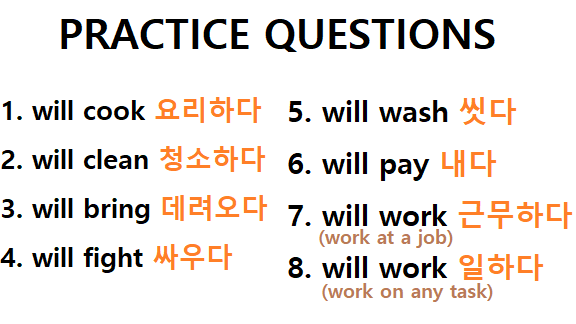
and that is all there is to the immediate future. I have practice questions for you and I need to re-emphasize that this form of the future tense is only used when you are cheerfully agreeing to do something for someone else. Like when someone asks "Can you verb for me" and you want to say "yes, I'll verb for you". That's when you use immediate future! Or if someone asks "Who will help me?" and you say "I'll do it!" That's when you use the immediate future. "I'll do it!" "hal-gge-yo!". 


Answers
1. will cook 요리할게/요리할게요/요리할겁니다 2. will clean 청소할게/청소할게요/청소할겁니다 3. will bring 데려올게/데려올게요/데려올겁니다 4. will fight 싸울게/싸울게요/싸울겁니다 5. will wash 씻을게/씻을게요/씻을겁니다 6. will pay 낼게/낼게요/낼겁니다 7. will work 근무할게/근무할게요/근무할겁니다 8. will work 일할게/일할게요/일할겁니다

Thursday, October 21, 2021

Future Presumptive

WATCH THE LESSON https://www.youtube.com/watch?v=4oi-NP2v8vY

Hello, my fellow students. This is our second lesson on the future tense. As I said in the last video, there are multiple ways to make the future tense in Korean. Each of them has a slightly different translation. The last lesson was on the Probable Future. This one is on the Future Presumptive and what that means that it is a way of stating intent. What do you intend to do in the future? You can describe what you intend to do by conjugating your verb into the Future Presumptive.

So how do we do it? How do we say "I intend to verb"?

Well, first, start with a verb. Any verb will do. Lets use 하다 (ha-da) to do.

First thing, as usual, we cut off the 다(-da)

하 (ha) 

then, we add the Future Presumptive ending which is very simply:

겠다 (get-da) 

하겠다 (ha-get-da)

and that is the infinitive version of the presumptive future. "to intend to do"

And now we have the infinitive version of the presumptive future. "to intend to do"

But we don't talk in the infinitive form. we want to say "I Intend to do", not "I to intend to do".

So, we have to conjugate this verb now. And we do that by using the same endings as we use when we conjugate into the simple present.

Let's review those endings. 겠다(get-da) is an ㅓ(eo) verb so the casual ending is -어 the polite ending is-어요 and the verb root ends in a consonant so the formal ending is -습니다 

so "intend to do"

is 하겠어, 하겠어요, 하겠습니다

So step 1. Cut off the -다 (-da)

step 2. Add a 겠다(get-da)

step 3. Conjugate the 겠다(get-da) using the simple present tense conjugation rules.


If you are not so comfortable with the simple present conjugation rules you could, Alternatively

cut off the -da and add the following endings is -겠어, -겠어요, -겠습니다

Chose which ever method you like. I think both these methods are equal in difficulty. 

Now, here is something important about this verb tense: it is very limited in how it can be used to state future intent. Since it means "intend to____". You can only use it in the first person to say "I intend to ____" or "we intend to blank" or you can ask someone "do you intend to ____?" But! It doesn't work the same in the third person. You can't say "that person intends to ___" or "those people intend to ____". You can not truly truly know what other people intend to do unless you are some kind of psychic mind reader.  So when you use future presumptive in the 3rd person the meaning changes significantly. What it translates to when you use it to make 3rd person sentences is "It looks like that person will _____." or "it seems like that person will ______." or "I think that person will ______."

And this sort of third person sentence makes more sense in certain situations than in others. When using the future presumptive to make 3rd person sentences you are best off using it to describe things which require some guess work. Like "It looks like that person will fall" Or "It looks like that soccer team will win" or "it looks like it will rain". 

Typically, you use the third person future presumptive to describe something that is not certain. Either because it is in the hands of fate, or involves a judgement call, or an opinion, or a guess... at least to some degree. So that is something you need to think about when deciding whether future presumptive is the best way to say what you mean. You don't really want to use it to say something like. "그 사람들은 컵케잌을 만들겠어요." to mean "It looks like they will make cupcakes" for example. Making cupcakes is a deliberate act that doesn't leave a lot of room for uncertainty and fate. Even if you are in a situation where they haven't told you what they are doing and you just see the mixing bowl and the sugar and you make a guess it is still not totally appropriate to use presumptive future to describe this situation. It should be used in a situation with even less certainty, or where an opinion is expressed. This is not something I can describe in a clear cut and dry kind of a way. You learn with experience what form of future tense is most appropriate. You might even consider NOT using the future presumptive for 3rd person sentences AT ALL. Just to be on the safe side.

But none the less, lets sum up:


3rd person sentences mean:

That person seems like he will_____

He/She/It/They seem(s) like he/she/it/they will_____

He/She/It/They look like he/she/it/they will_____

I think he/she/it/they will ______

I guess he/she/it/they will ______


Where as 1st person sentences mean

I/we intend to_______

and 2nd person questions mean

Do you intend to ______

We'll learn more about asking questions in later videos.

But there is another way to use the Future Presumptive. And that is with adjectives. In addition to "intend to _verb_." you can use it with adjectives and that makes sentences that translate as "seems like it will be _(adjective)_." or "looks like it will be _(adjective)_"

FOR EXAMPLE: 맛있겠어요 "Looks delicious" or 재미있겠어요 "Looks interesting/fun".

I don't want to confuse you too much more, but sometimes even when you are speaking in the 1st person you can have the translation "it seems like I will _(verb)__"  For example 저는 죽겠어요 (jeoneun juk-ge-sseo-yo) means "It seems like I will die" not "I intend to die." Korean is contextual like that. 

WATCH THE LESSON https://www.youtube.com/watch?v=4oi-NP2v8vY